

If your week already includes a few walks, a run or a couple of outings in the boat, it can be hard to see where the weights are going to fit. You're already exercising. You're busy. And the rowing machine is probably much more familiar than the squat rack.
Then along comes a headline like "Just Two Hours of Weekly Strength Training Cuts Women's Heart Risks". That's enough to make me look a little more closely.
What interests me is the connection between looking after your health and building the strength to do the things you enjoy. For women who row, there's another appealing possibility: the work you do with weights may help your performance on the erg, too.
A Big Study with an Encouraging Message
Researchers followed 117,025 women in the United States for an average of 14.5 years. Women who reported at least two hours of resistance training a week had a 20% lower relative risk of major cardiovascular disease and a 44% lower relative risk of heart attack than women who reported none. There wasn't a clear reduction in stroke risk. Women who kept up their training and worked both upper and lower body showed stronger associations.[1]
Those are striking numbers, but they need a little context. The researchers observed people's habits; they didn't randomly assign women to lift weights. So the findings show a link, rather than proof that strength training caused the lower risk. Activity was self-reported, and the associations became weaker after further allowance for body weight and cardiometabolic conditions.[1]
The percentages describe relative differences between groups, rather than a personal prediction. Two hours isn't a magic threshold, either. You can start with a manageable amount and build from there, with plenty to look forward to as you grow stronger and discover what you're capable of.
Make Some Room Alongside the Cardio
The British Heart Foundation makes a useful point: stronger muscles can make everyday movement and aerobic exercise feel less demanding. Its heart-health guidance includes both aerobic activity and strength work.[2]
That's a useful way to think about your week. Keep the walking, riding, swimming or rowing you enjoy, and give strength work a regular place too. The goal is a routine you can keep coming back to.
You don't need to be training for a race to care about this. Feeling more capable when you carry shopping, lift something from the floor or get up from a chair is a worthwhile goal in its own right.
And Then There's the Rowing
If you've ever watched your erg split creep upwards towards the end of a hard piece, you'll understand the appeal of getting stronger. But the research has a more interesting story than simply telling every woman to lift heavier.
In one eight-week study, 26 female university rowers used the same exercises with different loading programmes. One group progressed from three sets of 12 repetitions to three sets of five repetitions, using heavier weights. The other progressed from two sets of 15 repetitions to two sets of 32 repetitions with lighter weights. That's 32 repetitions in each set, not 32 sets! Both continued their rowing-related conditioning, and both improved their 2,000 m erg times.[3]
There was a pattern suggesting heavier training suited the experienced rowers better, while higher repetitions suited the novices. However, that difference wasn't statistically conclusive. It's an interesting clue for planning training, rather than a rule to apply to everyone.[3]
Another study followed young female rowers through nine weeks of training. Of the 26 recruited, 24 completed it. The authors reported greater gains in several strength and power measures with heavier training, but greater improvement in a 700 m erg test with strength-endurance training. Both groups also kept rowing.[4]
These girls were about 13, so I'd be cautious about applying their results directly to adult or masters women. What the study does illustrate is that improving a lift and improving a rowing test aren't quite the same goal.
A wider review found small benefits of strength training for rowing-specific performance, without establishing one type as clearly better than another.[5] Your experience, goals and the rest of your training week all deserve a say in the programme.
What About Masters Rowers?
For those of us looking beyond university-age athletes, the research offers some encouraging glimpses. A study comparing 16 male rowers, averaging about 68 years, with 18 similarly aged untrained men found larger trunk and thigh muscles, greater trunk strength and higher leg-extension power in the rowers. It was a comparison between groups, so it can't tell us which weights programme works best or how much lifting would improve an erg time.[6]
There is research in masters women, too. A 2026 study with a University of Canberra co-author asked how well masters rowers could recover and maintain their performance when racing several times in one day. To mimic a busy regatta schedule, 15 men and six women, averaging 48 and 50 years respectively, completed three all-out 1,000 m rowing efforts with 45 minutes' rest between them. The researchers measured rowing performance alongside responses in breathing, heart function, blood lactate and muscle power. The women maintained their performance across all three efforts. That's an encouraging glimpse of what trained masters women can do, although the study examined repeated-effort performance and recovery rather than the effects of a strength-training programme, and six women is a small sample.[7]
I'd love to see more studies directly comparing strength programmes in masters women. For now, these findings offer reasons to keep building capacity as you get older, while choosing your training from your own experience and recovery rather than borrowing a programme wholesale.
Find Your Level, Then Build from There
The university study included squats, deadlifts, lunges, rows and lat pull-downs. The younger rowers' programme included leg press and bench pull.[3][4] Neither tested individual exercises in isolation, so there isn't one proven winning lift.
If you're already active, you may be ready to begin with the medium options below. Keep the foundation versions available for learning a movement, returning after a break or adjusting a session. The hard options are there when you have the technique and strength to use them well.
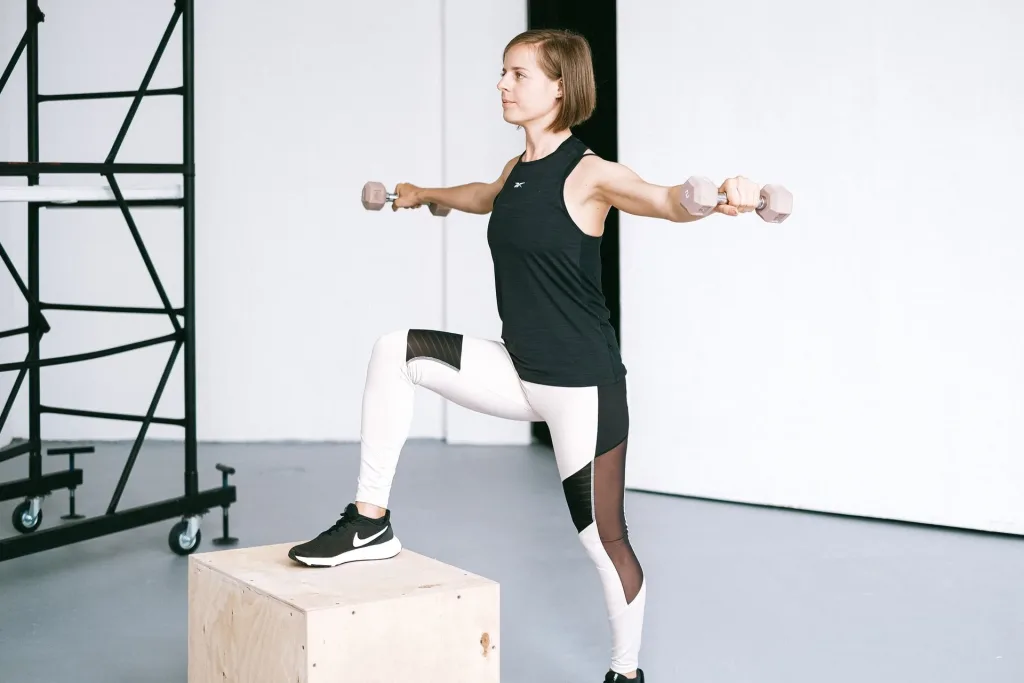
Squat: Build Strength Through the Legs
Foundation: Supported sit-to-stand or a bodyweight squat to a box.
Medium: Goblet squat holding a dumbbell or kettlebell at your chest.
Hard: Progressively loaded barbell front or back squat, with coaching and suitable rack safety supports.
Hip Hinge: Put the Hips to Work
Foundation: Practise an unloaded hip hinge, then a light kettlebell deadlift from a raised surface.
Medium: Dumbbell Romanian deadlift, lowering only as far as you can control the movement.
Hard: Heavier barbell Romanian deadlift or a trap-bar deadlift, with a load and range matched to your technique.
Pull: Strengthen the Upper Body
Foundation: Light resistance-band row.
Medium: Seated cable row or chest-supported dumbbell row with a challenging, controlled load.
Hard: Heavier chest-supported row or prone bench pull, maintaining control through every repetition.
Push: Give the Upper Body a Balanced Workout
Foundation: Wall push-up or push-up against a high bench.
Medium: Lower-bench incline push-up or dumbbell bench press.
Hard: Full floor push-up, progressing to added resistance, or a heavier dumbbell bench press.
Single-Leg Work: Build Strength on Each Side
Foundation: Supported step-up onto a low, stable step.
Medium: Controlled step-up holding dumbbells, or a split squat with both feet on the floor.
Hard: Loaded rear-foot-elevated split squat, using a stable support and a comfortable range.
Trunk: Support the Movement Around You
Foundation: A controlled dead bug or standing resistance-band anti-rotation press.
Medium: Half-kneeling cable anti-rotation press or side plank with knees bent.
Hard: Copenhagen side plank, supporting the upper knee on a stable, padded bench initially. Progress to supporting the ankle as strength and control improve, keeping the pelvis lifted and the body aligned.
These are coaching options, not a workout tested as a package in the studies. The labels are relative: load, range and control all change the challenge. A well-loaded goblet squat can be demanding, and you don't have to graduate to a barbell to make useful progress. Choose one suitable version of each movement rather than doing every level, and learn unfamiliar or heavier lifts with qualified coaching.
For rowers, remember that strength still needs to find its way into the stroke. Balance, timing and crew coordination matter on the water. The female studies here tested erg performance, so they can't promise a particular improvement in boat speed.
Give It a Place in Your Week
Australian guidance recommends muscle-strengthening activity on at least two days a week.[8] For a general starting structure, the British Heart Foundation suggests two to three strength sessions across the week, with recovery days between, and around 10 to 12 repetitions per set, building towards two or three sets as appropriate.[2] Experienced lifters can adjust repetitions and load to their goals; a heavier squat session and a strength-endurance session won't necessarily look alike.
I'd begin by finding two realistic spaces in the diary, allowing recovery between sessions and taking account of any hard rowing or other workouts. Start with manageable resistance and spend time learning the movements.
As an exercise becomes consistently comfortable, you can review the weight or repetitions with your trainer. You don't have to make everything harder at once. A small training record helps: what you lifted, how it felt and what is becoming easier.
If you have cardiovascular disease, uncontrolled blood pressure, significant symptoms or another condition affecting exercise, get individual medical advice before starting or making a substantial increase. Pain, injury and recovery also need to be taken into account.[2]
You Can Start from Where You Are
What I like about this research is the invitation it offers. Whether you want to feel stronger in everyday life, look after your heart or support your rowing, there's a good reason to explore strength training.
Whether your next step is picking up a heavier dumbbell, feeling more assured under a barbell or finishing an erg piece with a little more left in the tank, there's something satisfying about discovering your own progress. I hope you enjoy that feeling, and give yourself credit for the work along the way. Here's to getting stronger, enjoying the challenge and finding out what comes next.
Catherine Ashley
References
- [1] Zhang T, Zhang Y, Lee DH, et al. Resistance Training, Aerobic Activity, Television Viewing, and Risk of Major Cardiovascular Events in U.S. Women. Journal of the American College of Cardiology. 2026. doi:10.1016/j.jacc.2026.04.036. Read the abstract.
- [2] British Heart Foundation. Best Exercises for Heart Health. Practical guidance on aerobic and resistance exercise, recovery and adaptations for heart conditions. Read the guidance. Accessed 22 October 2026.
- [3] Ebben WP, Kindler AG, Chirdon KA, Jenkins NC, Polichnowski AJ, Ng AV. The Effect of High-Load vs. High-Repetition Training on Endurance Performance. Journal of Strength and Conditioning Research. 2004;18(3):513-517. Read the abstract. Free full paper (PDF).
- [4] Thiele D, Prieske O, Lesinski M, Granacher U. Effects of Equal Volume Heavy-Resistance Strength Training Versus Strength Endurance Training on Physical Fitness and Sport-Specific Performance in Young Elite Female Rowers. Frontiers in Physiology. 2020;11:888. doi:10.3389/fphys.2020.00888. Free full text.
- [5] Thiele D, Prieske O, Chaabene H, Granacher U. Effects of Strength Training on Physical Fitness and Sport-Specific Performance in Recreational, Sub-Elite, and Elite Rowers: A Systematic Review With Meta-Analysis. Journal of Sports Sciences. 2020;38(10):1186-1195. doi:10.1080/02640414.2020.1745502. Read the abstract.
- [6] Asaka M, Usui C, Ohta M, Takai Y, Fukunaga T, Higuchi M. Elderly Oarsmen Have Larger Trunk and Thigh Muscles and Greater Strength Than Age-Matched Untrained Men. European Journal of Applied Physiology. 2010;108(6):1239-1245. doi:10.1007/s00421-009-1337-6. Read the abstract.
- [7] Rios MJ, Cardoso R, Monteiro AS, Pyne DB, Vilas-Boas JP, Fernandes RJ. Male and Female Master Rowers Physiologically Resilient to Repeated Maximal Efforts? Journal of Strength and Conditioning Research. Published online 10 June 2026. doi:10.1519/JSC.0000000000005565. Read the abstract.
- [8] NSW Government. Physical Activity Guidelines for Adults. Australian recommendations for aerobic activity and muscle strengthening. Read the guidance. Accessed 22 October 2026.